Showing posts with label Common Errors in English Usage Calendar. Show all posts

7.17.2017

A great question: "If I was" vs. "If I were"

Over in the comments on the calendar site, Reader 13c11a (we don't have readers with uninteresting names) asked a great question:
In the piece below, which is correct--was or were--and why? Thank you very much.
He repeated that he would neither have the IV removed nor let me go. He went on to explain that he could not discharge me because I was in serious condition. I argued that I couldn’t have been lawfully admitted and that I was going to leave. He explained that he admitted me as an emergency and that I was far too ill to leave. I explained that I had two twenty year old cats at home who were expecting me to return on time to feed them. He was a broken record: he would not allow me to leave. I thought this strange because he was half my age. I don’t know why I thought that mattered. It was as though he was/were wearing a badge and I had been pulled over.
  I replied:
What a great question, and that is an engaging and interesting piece of creative prose! I commend you, 13c11a, if this is original to you.
Around here we don't like technical terms so much, so in keeping with  that I'll just say that any time you're talking about something that could never be true you use "If I were," as in "If I were you. . . . " Conversely, it's natural to say, "If I was off course, I wasn't aware of it at the time," because it's entirely possible that you might have been on or off course.
But then it gets slippery, especially since you can't always say it's one or the other. The song goes "If I were a rich man," which is fine. I get it. Tevye in Fiddler on the Roof isn't a rich man, so the statement is not true. But is there a context for "If I was a rich man"? How about "If was a rich man then, I certainly didn't feel it at the time"?
Or how about if Tevye had just plain sung it, "If I was a rich man," with all of his life circumstances just as they are? Would that be so wildly out of bounds? No, not really, because in modern usage the "were" is not required in every case that it could be used. I'd argue no one would bat an eye at "If I was a rich man, all day long I'd biddy biddy bum, if I was a wealthy man."  
Certainly in creative prose you can let your ear guide you somewhat. In my opinion, "It's as though he was" would read better than "It's as though he were" in your passage. I could even argue it is more correct because it strengthens the metaphor of nurse/cop and patient/suspect. That is, if you go with the idea that "If I were" is for cases that are impossible and "If I was" is for cases that may or may not have been possible in the past, you can nudge your metaphor toward the latter interpretation and make the poetic declaration of "He was a cop, and I was his suspect" simply by choosing "was" over "were."
If you do want the technical term, you call this the subjunctive mood, and a good discussion of the point is on the English Language & Usage site.

4.16.2013

Peter Workman: A giant, engaged


If you go look at the Workman Publishing story about the passing of Peter Workman, you will notice something that all of us who ever had any contact with him already knew: Here was a person entirely connected to his work. His work happened to be heading an industry-defining publishing company for nearly half a century, but it was clear to me in the, oh, three minutes that I talked to him, that he was completely active in the process of publishing.

He clearly did not need to be. Workman Publishing was hugely successful from the minute he founded the company, publishing Yoga: 28-day Exercise Plan, which remains in print with sales that are still enviable. Other big successes were the "What to Expect" books for family planning and parental advice, and the "1000 Places to See" series of books. A third of Workman titles has sold more than 100,000 copies. No, the man who founded this company could have checked out long ago, claiming victory into a well-funded retirement.

Among those great successes was the invention of the tear-off daily calendar, the perfect pre-Internet medium for word-of-the-day, fact-of-the-day, cartoon-of-the-day, or the visually driven (and sure-fire hit, naturally) cat- or dog-of-the-day. These calendars, all produced with the Workman Publishing "Page-A-Day" brand, were a revelation in 1979, when the first of them began to hit the bookstore display tables around Christmas.

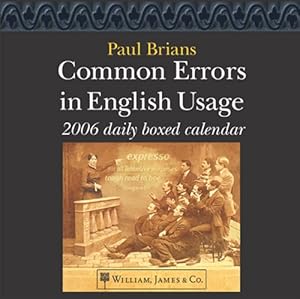
And that is where I come in. It's a little embarrassing to admit that I knew nothing of the history of these desk calendars when I had the idea to create one from Common Errors in English Usage. It seemed an ideal fit: not word-a-day but usage-point-a-day. And so, sometime in 2005 I developed the Common Errors in English Usage Page-A-Day calendar, filled with 365 pages of entries to be cycled through the course of 2006, each with its own page. We produced a very limited number of these, sort of a market test of 1000 copies. I was entirely ignorant of the fact that the most egregious error appeared right there on the box design and title page.

At some point I learned from a catalog company that would feature the calendar that the "Page-A-Day" label was actually a brand name owned by Workman Publishing. This was a problem. The artwork for the calendar had already been proofed and approved with the printer. Everything was in motion, and the motion needed to stop until this issue got resolved.

I put them on notice at the printer immediately. Fortunately, the calendar had not been produced, but unfortunately there would be delays for another round of proofs, and the schedule was too close for comfort already.

I decided to call Workman Publishing. I expected nothing noteworthy to come of this. Workman, I figured, is huge. It's corporate. I'm going to be tied up for three weeks with this mess, waiting for some legal assistant to get back to me. In short, I'm sunk. I was asking for something that seems silly in hindsight: permission to use the brand free-of-charge for an extremely small run of test-market calendars with the promise to cease and desist thereafter. In times like those, you just take your best shot and go for it.

I was in for a few surprises over the next couple of days. The first surprise was that when I called Workman Publishing, the person answering the phone knew exactly the company policy and had an authoritative answer for me right then and there. She listened to my story, though, and sympathized enough to give me some small hope that I might actually be able to proceed. This was late in the day, though, and she told me I'd have to wait to get a final, definitive answer after she had had a chance to talk to Peter about it.

"What?" I thought . . . talk to Peter about it? What about Legal? Isn't there going to be a Long Process of going through the copyright attorneys and Team of Experts for advice and consent? Hmmm . . . the only thing to do was the wait, and try to do so patiently.

I don't remember waiting long, though. I had to overnight a proof of the box and the title page for review, but it was not more than two days later that the phone rang in the office. The intercom beeped for me to pick up; Peter Workman was on the line.

This was getting surreal. I assumed, maybe, that this was a misunderstanding. Peter Workman could not possibly be calling me. Rather, this was Workman Publishing calling back, and not the actual Peter himself. I picked up the phone and gave one of those slightly garbled, nervous "hellos" you save up for when you meet people that are famous. Indeed, "This is Peter Workman" was the announcement I heard on the line. It was business, but there was no denying the underlying personality there, the charisma that sold a million copies.

I can't recount the whole conversation—I would just be making it up anyway. All I remember is that the answer was "No" to allowing any use of Page-A-Day for a non-Workman product, and that was A-OK with me. He gave bad news with the best of them. He said he needed to protect the brand, but that he understood very well the pickle that put me in. I figured he would know a thing or two about pickles, but there was also an element of "This is Peter Workman telling me I need to solve my publishing problem on my own," and coming directly from the man that was, well, inspiring.

The upshot of it is that the calendar was produced with the generic "Daily Boxed Calendar" label, and went on to appear in print for the next five years, largely with the help of Barnes & Noble, who even produced it with their own publishing imprint the final year that they had a calendar imprint. I worked with many great people there, but there was one huge difference with all the success of the calendar following that initial big flop: I could have never gotten on the phone with a Mr. Barnes or a Mr. Noble.

But don't take my word for it: read the comments at Workman Publishing to get a clearer picture of how engaged this publishing giant was. It spanned every minute of his career, not just the three spent on the phone with me to deliver some bad news in the best way possible.
12.30.2011

A wrongly presented common error

As I go through my list of available common errors for the daily entry to the calendar, I come across some that have been removed from or significantly revised on the Common Errors in English Usage Web site. When this happens, I am often alerted by readers who point out something amiss in the entry. Here was the entry from December 29, 2011:

wrongly/wrong

“Wrongly” always precedes the verb it modifies: “He was wrongly suspected of having
used garlic powder in the lasagna.” “Wrong” is the word you want after the verb:
“She answered wrong.”
To which two readers responded with essentially the same (valid) point:

This is interesting.  I would say "She answered incorrectly."  I would not say "She
answered incorrect."  How is wrongly/wrong different?

I would also say "She was incorrect" not "She was incorrectly."  As I would say "She
was wrong."
and:

"She answered wrong" seems wrong to me.

Her answer was wrong (adjective modifying a noun).  She answered wrongly (adverb
modifying a verb, regardless of pre or post position relative to verb).  Similarly: 
"She answered incorrectly" and not "She answered incorrect."
I looked back at the Common Errors site and discovered that this was a case where the entry had been removed, though I still had it listed among the entries I use to create the daily entries. The point is not that the entry is wrong, but the entry is not fully fleshed out. If you have been saying "She answered wrongly," you are not grammatically incorrect, but the word "wrong" also does something that the word "incorrect" does not: it serves as an adverb as well as an adjective.

I still like the guideline of the entry: "wrongly" goes before the verb it modifies. But that is a guideline, not a comprehensive usage rule. It is perfectly correct (and necessary) to say, for example, "She was accused wrongly," if you are using that sort of inverted construction.

If you thought you observed something wrong about this entry, you were right!

My apologies for any confusion.

11.23.2011

The "Thank You" card that never was, but actually may be yours now

Today's Thanksgiving Day (US) calendar entry reminds me that once upon a time there was a thought of producing occasional cards based on Common Errors in English Usage. The idea never got off the ground, maybe in part because of the difficulty of pulling it off for several different occasions.

But then again, there was "thankyou, thank you/thank-you," which I thought actually made a decent card. Here was the outside of the card I dreamed up:
And then when the card was opened, there was this:


So, OK. There are better "thank you" cards out there, I'll admit, but did you ever see one that came with a usage tip? (And no fair saying the two don't mix—that's dodging the question!)

Happy Thanksgiving (US) to you, and if you want to use this card yourself for your own thanking needs, here is a downloadable, printable, trimmable, foldable version (for a usable card, use two-sided printing; the crop marks will guide you to proper trimming and folding, and no, I am not available for tech support):
Thank You card—outside
Thank You card—inside

7.08.2011

The overwhelming success of the Common Errors in English Usage Calendar mailing, and why it will never be the same again

If you are reading this, you are probably already a subscriber to the Common Errors in English Usage e-calendar, and you have probably noticed some changes in its appearance over the past few days. If you are reading this and are not a subscriber to the Common Errors in English Usage e-calendar, what are you waiting for? Go here to subscribe.

I've been getting some questions and comments about this, so I'll take a moment to explain. Before I started the e-calendar, I had never managed an e-mail list. I had no idea what I was in for, but to the extent that I did understand what was involved, I figured it was a matter of adding subscribers to a list, deleting unsubscribers from that same list, and lining up daily entries to be delivered to the list.

And guess what? I was right about that for several months. That really was all that was involved. It took a little time, but I was having fun. From time to time I would get responses from subscribers who had something to say about a particular entry, and I figured all was well.

Something happened, though, a few weeks ago. All of a sudden my e-mail program stopped delivering the entries. I will spare everyone the technical workaround that our e-mail technician devised in order to continue the mailings, but I will add that my Internet service provider must have noticed I was sending out quite a lot of e-mail in a short period of time every day, and so began limiting the amount of e-mail I was allowed to deliver at one time. The only solution, short of getting a reasonable human at my Internet service provider who happened to understand my problem and knew how to make the appropriate changes (not possible, apparently), was to break down the list into eleven different parts and stagger their delivery over a period of about three hours.

Needless to say, this was not tenable over the long term. Though very time-consuming, I managed to continue the mailings while seeking out an alternative, which turned out to be a mail service (Comm100) that provides e-mail delivery for non-spammers such as I, and also maintains a policy of not collecting e-mail addresses of subscribers to be used for other purposes. I am very happy with this situation, and I hope the subscribers to the e-calendar are, too.

This is my (overly) detailed explanation for the new look of the e-calendar. Some feedback I have received will help me improve its appearance, and I look forward to the rest of the year. If you have comments, please add them below.

6.13.2011

I know little and could care less about this error

I'm not surprised to learn that many subscribers to the e-calendar have their favorite, or rather least-favorite, usage errors. I frequently get requests to feature one error or another because a reader feels the need to raise more awareness of it. Or, as happened this morning, I get a response thanking me for featuring an error (in this case it was "shrunk" where "shrank" would be the correct form) that the reader has seen or heard just one time too many.

But yesterday's entry ("could care less/could not care less") is one that--though I agree with Paul that the phrase should logically be "couldn't care less"--I have learned to live with. I haven't given up on it as a lost cause; I've just created my own little explanation for how it came to be, and have chosen to ignore all available logic and scholarship concerning its use. I've retreated into my own musings over where it came from. What follows is not even folk etymology; it's just my own secret theory, my own private Idaho.

My completely unfounded explanation for the expression "could care less" comes from an experience of listening to an interview conducted by Lewis Lapham on his radio show about two years ago (no recollection which broadcast it was, unfortunately). At some point in the interview, Lapham presented his guest with an opportunity to explain something to us listeners: "Most Americans," Lewis said, "know little and could care less about [something related to guest's area of expertise]." No, I cannot remember the topic, but suddenly I had a revelation about "could care less." What if, I thought, that expression entered English as a truncation of the (less common, but perfectly logical and prevelent) phrase "know little and could care less"? Everything fell into place for me. Suddenly the phrase that made no sense at all turned on its head to one that worked perfectly well.

After all, "could care less," when contrasted with "couldn't care less" doesn't seem to have much kin in American English. We don't sarcastically say "I give a damn" when we mean "I don't give a damn," for example. We say "like I care" rather than "like I don't care." I'm hard pressed to think of widespread use of phrases that sarcastically insert negations to their meaning.

And so I choose, in my mind, to allow for that. I tell myself that the phrase is short for "know little and could care less." I can even imagine that the phrase "couldn't care less" came along later than "could care less"; that is, I could imagine a speaker using the phrase "could care less" without the preceding "know little and," and a listener chiming in to correct it to "couldn't care less," thus creating a pat expression where there was not one before. I do this fully aware that I have absolutely nothing to back me up; a query to the noted language writer Nathan Bierma about it led nowhere, and Google shows me nothing. This is a conclusion I've allowed to myself free of the rigors of any serious research or scholarship whatsoever. Yes, I feel bad about that, but no, not so bad that I'd change any of it. I cannot abandon this inner bliss in favor of profound regret.

One final note: I never use either "couldn't care less" or "could care less" in my own speech and writing, and I think the bigger point to make is that there is nothing fresh or exciting about either one. Use "know little and could care less" if you must. Even the great Lewis Lapham does it, apparently, but I would stay away from the straight "couldn't care less," logical though it may be.

And as for raising our hackles, some of us need to leave room for "shrunk" vs. "shrank."

10.26.2010

Is there a 2011 Common Errors in English Usage Calendar?


FORGET ABOUT THE "LATEST UPDATE." THIS IS THE REAL LATEST UPDATE: The e-calendar has its own Web site for 2012 and a new way to subscribe or renew your subscription. Read all about it here.
LATEST UPDATE: The e-calendar will continue in 2012. To subscribe, send me an email: tsumner@fbeedle.com.
UPDATE: The e-calendar daily mailings are now available. To subscribe to the list send me a request: tsumner@fbeedle.com.

I've titled this post after a question that comes in just about daily around here, as many are scrambling to find the 2011 calendar on the William, James website or at Amazon, or through their local Barnes & Noble or other bookstore. The disappointing answer is No, there is not a 2011 edition of the calendar.

However, there is some work underway toward developing an e-calendar to be delivered to your e-mail inbox each day. The cartoons? They'll be there when applicable. The accompanying literary quotes? Yes, sometimes.

Changing times in the calendar
business have forced our hand
Assuming this comes together, it will be just like the calendar many of you have seemingly enjoyed for the past several years, except you won't have to deal with the plastic easel on January 1, 2012. Plus it'll be completely free. 

If you are interested in signing on for a daily dose of Paul Brians' interesting and witty entries on English language usage, drop me a line: tsumner@fbeedle.com with the subject line "2011 e-calendar," or something like that. Your address will be used only for delivering the daily entries.

I've had more fun than I should have had putting together the calendar for the past five years, but changing times in the calendar business have forced our hand in discontinuing this item. That does not mean, however, that it will not be revived. To find out about that, you'll have to check this space next year for a post titled, "Is there a 2012 Common Errors in English Usage Calendar?"

10.08.2010

Free Calendar at Wordstock--the ultimate remainder

It's the ultimate remainder. The Common Errors in English Usage 2010 edition will be followed by . . . nothing. This is the last chance to grab yours, and best of all it's free if you stop by the Franklin, Beedle & Associates booth at the Wordstock Festival this weekend, October 9-10. One caveat: to make the calendar current you'll have to fast forward to the current date. Then you'll enjoy three (well, nearly three) full months of entries from the remainder of the year.

So there you have it: The Ultimate Remainder. Free, good for the remainder of the year, and not renewable. Will there be a 2012 edition of the calendar? A 2013? Let's just say it's all up in the air for now. Come down to Wordstock and grab this one FREE. May be your last, best shot.

12.09.2008

More Holiday Shopping Possibilities

The 2009 Common Errors in English Usage Daily Boxed Calendar has been sold at a lower price this year than in years past, just $11.95. But this good deal just got better for the holidays. We're now offering the calendar at a 5% discount for orders of 5-9, and 10% discount for orders of 10 or more on our calendar page.

Plus, unlike some online retailers, we are able to promise delivery by Christmas day for orders placed in a timely manner (but I remember that last year's edition sold out early, so you may want to time your purchase accordingly). I'm just not sure there's a better idea or a better deal for your holiday gift-giving out there anywhere. Is there?

3.14.2008

National Grammar Day's Martha Brockenbrough reads Paul Brians; gets the wrong message

Nathan Bierma points out that Martha Brockenbrough, who serves as grammar guru for Microsoft's Encarta web site, where she writes a column called "Grumpy Martha's Guide to Grammar and Usage," endorsed March 4 as National Grammar Day. According to Nathan,
. . . she takes Elvis to task -- is no one sacred? -- for singing "I'm all shook up" instead of the proper "all shaken up."

Raise your hand if you prefer this correction. That's what I thought.
Now you can raise your hand if you recognize that this has been addressed by Paul Brians:
Elvis Presley couldn’t have very well sung “I’m all shaken up,” but that is the grammatically correct form. “Shook” is the simple past tense of “shake,” and quite correct in sentences like “I shook my piggy bank but all that came out was a paper clip.” But in sentences with a helping verb, you need “shaken”: “The quarterback had shaken the champagne bottle before emptying it on the coach.”
Last year I used this as a jumping off point for the Common Errors in English Usage Calendar entry for January 8, Elvis' birthday. The difficult-to-read caption you see on that page is this:
His unpopular act included grammatically correct hits of the fifties, all with harp accompaniment: “All Shaken Up,” “Whom Do You Love,” “There Is a Whole Lot of Shaking Going On,” etc.
I didn't know that Martha Brockenbrough would take home the wrong message from that, but she ought to have at least figured out the sarcasm by the time she got to Dylan's birthday, covering Brians' entry on ain't:

That's a little hard to read. Here's Paul's entry:
“Ain’t” has a long and vital history as a substitute for “isn’t,” “aren’t” and so on. It was originally formed from a contraction of “am not” and is still commonly used in that sense. Even though it has been universally condemned as the classic “mistake” in English, everyone uses it occasionally as part of a joking phrase or to convey a down-to-earth quality. But if you always use it instead of the more “proper” contractions you’re sure to be branded as uneducated.
And my caption reads like this:
And from his catalogue of sixties hits: “I Am Not Going to Work on Maggie’s Farm Anymore.”
The point, Martha, was that his act was unpopular; that is, there's a time to rock and a time to write formally. Your intrusions into our times to rock are not any more appreciated than our harp-playing entertainer's.

Geoffrey Pullum weighs in, pointing out that other of the King's hits could be subject to Martha's edit:
  • Treat Me Nicely
  • Do Not
  • Love Me Tenderly
  • I Cannot Help Falling in Love
  • Do You Not Think It Is Time?
  • I Do Not Care If The Sun Does Not Shine
  • It Is Not Any Big Thing (But It Is Growing)
  • Is That Not Loving You, Baby?
And by email points out that a Fats Waller hit could have been written by Martha as "I am not misbehaving," to which I say, "Your feet are too big," anyone? That's what I thought.

2.27.2008

Common Errors in American Holidays

Over there at Amazon, a reviewer has this comment on the February 18, 2008, page for the Common Errors in English Usage calendar:
Maybe in 2009, a new entry could be the error in the placement of the apostrophe for President's Day on the entry for Monday, February 18, 2008. The common usage is Presidents' Day. How disappointing for a calendar touted as "Common Errors" in English Usage has a common error of its own! Other than that annoyance, I have really enjoyed the calendar.
Which is the kind of comment one has to admire for its willingness to jump right into the thick of things, getting in on the Common Errors action. Logically speaking, of course, the day honors all the U.S. presidents, not just one, so therefore the absolutely correct way of styling this holiday requires a well-placed apostrophe following that final "s": "Presidents'."

I like that logic so much that I've decided to take the commenter's advice and label February 16, 2009, as "Presidents' Day" in next year's edition of the calendar. Using my Google Book search, I see that almost every children's book available styles the holiday as a plural possessive, and it is probably a more acceptable way of presenting the day in front of a crowd likely to appreciate the Common Errors in English Usage calendar. Chalk one up for the Amazon commenter and for the wonders of Web 2.0, which allows for such dynamic exchange of ideas. Yay!

But if you detect a certain lack of embarrassment for having brought this up, if you sense that I'm not contrite about having made the mistake of misplacing this apostrophe, let's just say your intuition has not failed you.

I know I'm given to citing Geoff Pullum a fair amount, but I figure the co-author of the biggest, most revered book on English grammar available ought to know a thing or two about how to approach usage. Here is Geoff discussing the style of another holiday, Patriots' Day (celebrated in the state of Massachusetts):

Why are they all grammatical?

  • Patriots Day uses the plural noun patriots as an attributive modifier in a singular noun phrase with the head noun day, as in weapons cache or activities center.
  • Patriot’s Day uses the genitive singular noun patriot’s as the determiner in a singular noun phrase with day as head, as in my MTV, or in Jeeves's description of his profession, gentleman's gentleman.
  • Patriots’ Day uses the genitive plural noun patriots’ as the determiner in a singular noun phrase with day as head, as in workers' pay or ladies' room.
You would like to think that even Geoff is wrong, though. You'd like to think that there really is a correct way to do these holidays, that you could at least look at the most official source there could be for it, something super official-looking such as a Federal Holidays Web Page. Maddeningly, the most official-looking government page on the matter lists the holiday with its still-most-official title: Washington's Birthday. Over at the post office, where they take their holidays seriously, the singular possessive form is used, though it is set next to the "Washington's Birthday" designation, so it's possible they're just doing this to be consistent with that.

Wikipedia tells us that the plural form, either possessive or not, is currently the norm, but
President's Day is a misspelling when used with the intention of celebrating more than one individual; however, as an alternate rendering of "Washington's birthday," or as denominating the commemoration of the presidency as a singular institution, it is a proper spelling. Indeed, this spelling was considered for use as the official federal designation by Robert McClory, a congressman from Illinois who was tasked with getting the 1968 federal holiday reorganization bill through the House Judiciary Committee.
Wikipedia's justification for using the singular possessive form varies from Pullum's justification for "Patriot's Day," but there's enough justification, I would argue, to style it that way if you want. Plenty of edited material can be found in books to justify the singular possessive. Indeed, The Starr Report prefers it when detailing the Clinton/Lewinsky break-up date in 1998, possibly the most important Presidents' Day event of the past quarter century!

I myself have been wildly inconsistent. In the 2006 and 2007 editions of the calendar I styled the holiday as a plural possessive. Aesthetically, I prefer the singular possessive, and I think that is what took hold of me when I decided to do it that way for 2008. I figured no one would care. Silly me.

12.12.2007

Where have all the calendars gone?

******
UPDATE: The 2009 Calendar is available to preview and order here.
******

******
UPDATE: The calendar seems to have sold out at Amazon, and we have told Amazon we cannot ship orders to them for this calendar, but as of this update, their message is that the calendar is "temporarily" unavailable. Please be advised that Amazon will not be able to fill any more orders, unless they find some (unknown to us) source for the calendars.
******

It's a happy day here at William, James & Company. That is, it's a fine day if you can rejoice over the success of the 2008 edition of the Common Errors in English Usage desk calendar. For the first time in its three-year history, we have officially sold out our run.

But let's look at this news from the other side. Suppose you had been hoping to do something like, you know, actually BUY the calendar, maybe GIVE it as a GIFT in the coming holiday season. Maybe not such good news, in that case.

And yet hope springs eternal. If you are seeking this calendar, you have a few options available. Just because we cannot fill any more orders for this item does not mean that, for example, AMAZON cannot. In fact, at least for the time being, they can.

But suppose by the time you are reading this that Amazon shows the calendar as sold out? Barnes & Noble, in their infinite wisdom, has stocked its own private-label edition of this calendar in their stores. Perhaps you could try calling your local Barnes & Noble store to see if the calendar is still available there (You can use this ISBN to help the clerk search inventory: 978-0-7607-9347-3). You may likewise call your other favorite local bookstore and see if they can order the calendar through their distributor (in that case, try this ISBN: 978-59028-195-6).

Other possibilities exist for finding online vendors for the calendar, should Amazon fail you. You could Google the phrase 2008 common errors in english usage calendar and try clicking on some of the results.

We're happy the calendar has sold so well, of course, but we are not happy for any inconvenience this may have caused. But let's not dwell on that; let's just call it an opportunity for our customers to be resourceful. Isn't the prize more enjoyable, after all, when you've had to work for it?

10.26.2007

Paul Brians featured on The Daily English Show

It was Mistake Day on The Daily English Show, a webcast by Sarah Lilburn at Acadia University, and the featured site was Paul Brians' Common Errors in English.

Of course, if you own the calendar based on the book and site, every day can beMistake Day!

12.04.2006

The William, James Cata-blogue: The 2007 Common Errors in English Usage Calendar


For end-of-year gift giving, the William, James cata-blogue begins with The Common Errors in English Usage 2007 Daily Boxed Calendar. It’s the only item we produce specifically to meet your end-of -year gift giving needs.

The 2007 calendar follows the success of the 2006 edition. For a little bloggy-good back story, producing a daily calendar from the book was discussed right from the very start. Working on the production of the book in 2003, we thought of making the calendar, but decided to wait for the book to come out and prove itself first.

The book is a big hit, and now the calendar joins the club The entries in the latest version include no repeats from the 2006 edition, plus a hundred new captions with vintage illustrations to accompany the text. Also new for 2007 are many examples from classic literature of the points discussed each day. As fun as the 2006 edition was, we think the 2007 edition is even moreso [COPY WRITER: “more so” should be two words. Groucho Marx was never meant to be consulted for usage--please check Brians’ book --Ed.].

The calendar is a lot of fun to make, and it’s just the ideal gift for the desk-bound word-and-usage lover on your gift list.

Order the calendar online through William, James & Company on our secure site. We offer volume discounts, and shipping is free and timely in the continental U.S.